There is a moment in building a guitar where you stop shaping individual pieces and start thinking about resonance as a system. The neck, the body, the bridge, the strings, the wood grain that runs under all of it: they either work together or they fight each other. Get it right and the instrument sings. Get it wrong and no amount of talent fixes the physics.
Enterprise infrastructure works the same way. You can have the fastest GPUs on the planet, the densest object storage cluster available, and the most efficient backup software money can buy. But if your network is the bottleneck, none of those assets reach their potential. The data pipeline chokes. The performance never shows up where it counts.
Remote Direct Memory Access, RDMA, and specifically its application to direct GPU-to-storage workflows and S3 object storage, is the architectural shift that changes this equation. It is not a minor optimization. It is a redesign of how data moves through modern infrastructure, and the implications reach far beyond AI workloads.
What RDMA Actually Does
To understand why RDMA matters, you have to understand what it replaces. In a traditional network I/O model, data movement is mediated by the CPU and the operating system kernel. A storage read triggers a system call, the kernel allocates buffer space, the data moves from the network interface card into kernel memory, gets copied into application memory, and the CPU orchestrates every step. This works fine for transactional workloads at reasonable scale. It falls apart under the throughput and latency demands of modern AI infrastructure.
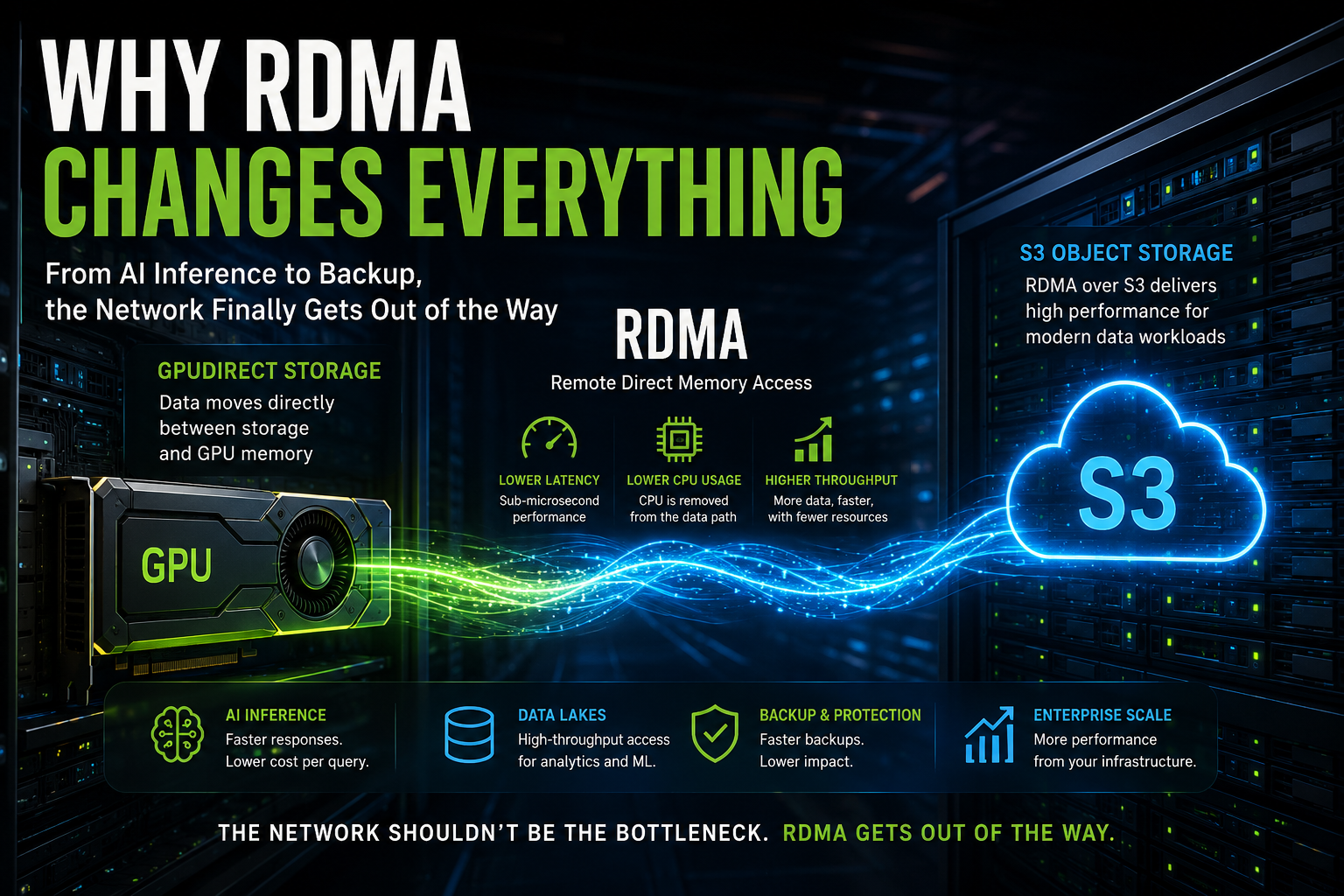
RDMA eliminates the CPU from the data path entirely. A properly configured RDMA connection allows one machine to read from or write directly into the memory of a remote machine without interrupting the processor on either end. The data transfer is handled by the RDMA-capable network adapter. Latency drops from microseconds into the sub-microsecond range. CPU cycles that were previously burned managing network I/O are returned to the application doing actual work. At scale, this is not a marginal improvement. It is a fundamentally different operating condition.
The two dominant transport implementations you will encounter are InfiniBand, which is natively RDMA-aware and predominates in high-performance compute clusters, and RDMA over Converged Ethernet, or RoCEv2, which brings RDMA semantics to standard Ethernet fabrics. Both deliver the core benefit. The choice between them is an architectural and cost decision based on your existing infrastructure and the workloads you are running.
RDMA eliminates the CPU from the data path entirely. Latency drops from microseconds into the sub-microsecond range.
RDMA Direct and AI Inference: Removing the Last Bottleneck
The AI inference use case is where RDMA direct, specifically NVIDIA GPUDirect Storage, produces its most dramatic results. Inference requires feeding model weights and activation data to GPU memory at very high throughput and very low latency. The model has to be there when the GPU needs it. Any delay in that supply chain directly degrades inference performance and drives up the cost per query.
GPUDirect Storage creates a peer-to-peer DMA path between GPU memory and NVMe or network storage. Data flows directly into the GPU frame buffer without staging through system RAM and without consuming CPU cycles. The bottleneck that previously existed at the host memory and CPU layer simply does not exist in this architecture. For large language models, multimodal models, and inference workloads that need to serve requests at scale, this changes the economics completely.
Consider what this means operationally. An inference cluster feeding from a high-performance object storage backend over RDMA can sustain throughput that would otherwise require either larger GPU buffers, more CPU resources, or higher-cost local NVMe tiers. The storage layer becomes a genuine first-class citizen in the compute architecture, not an afterthought bolted onto the side of a GPU cluster.
This is particularly relevant as organizations move away from hyperscaler GPU clouds and toward dedicated neocloud infrastructure. When you own the full stack, the network fabric is a design choice, not a constraint handed to you. Designing that fabric with RDMA in mind from the start is the difference between infrastructure that scales and infrastructure that struggles.
RDMA over S3: The Protocol Shift That Redefines Object Storage
S3 has become the universal interface for unstructured data. It is the language that AI pipelines, backup software, analytics frameworks, and cloud-native applications all speak. The challenge has always been that S3 over standard TCP/IP introduces overhead at exactly the layers where modern workloads are most sensitive: latency and CPU consumption at the client side.
RDMA over S3, extending RDMA semantics into the object storage access path, changes this in a fundamental way. The object storage client can issue S3 operations over an RDMA transport, meaning the data path from the storage cluster to the requesting application bypasses the traditional kernel network stack. For workloads that make thousands of concurrent small object requests or stream very large objects at high throughput, the impact is measurable and meaningful.
What makes this especially relevant to enterprise architects is that S3 is no longer just a cloud construct. On-premises object storage platforms have standardized on S3 as their primary access protocol. Backup platforms call S3-compatible object stores directly. Data lake and lakehouse architectures depend on S3 access patterns. AI training pipelines stage datasets into S3-compatible repositories. The reach of this protocol improvement spans every major use case in the modern data center.
The storage layer becomes a genuine first-class citizen in the compute architecture, not an afterthought bolted onto the side of a GPU cluster.
Backup and Data Protection: The Overlooked Beneficiary
The AI conversation tends to dominate discussions of RDMA, and that is understandable given the performance numbers. But backup and data protection workloads may actually be the use case where the operational impact is most immediately tangible for the broadest range of organizations.
Modern backup architectures are moving toward direct-to-object patterns. Enterprise backup platforms can write directly to S3-compatible object storage, bypassing traditional media servers and secondary landing zones. This is cleaner architecturally and simpler operationally. The problem is that large-scale backup jobs are inherently throughput-intensive. Backup windows have real business constraints. When you are protecting hundreds of terabytes or petabytes, the speed at which you can stream data to the object repository determines whether you meet your recovery point objectives or you spend your mornings explaining to the business why the backup did not finish.
RDMA over S3 brings the same throughput and CPU efficiency improvements to backup workloads that it brings to AI workloads. Backup clients can stream data to the object store at much higher effective throughput. The server-side CPU on both the backup client and the storage platform stays available for other work rather than spending cycles on network stack processing. Backup windows compress. Recovery operations, which are often more latency-sensitive than backups, benefit from the same low-latency data path.
For organizations running Veeam, Commvault, Veritas, or any modern backup platform with S3 target support, RDMA-capable object storage infrastructure is not a distant future consideration. It is an available upgrade to the backbone of their data protection strategy.
Day-to-Day Object Storage Operations
Beyond the headlining use cases, RDMA’s impact on general object storage operations compounds over time in ways that do not always make it into benchmark conversations.
Object storage clusters serving mixed workloads, AI data pipelines running alongside backup jobs alongside analytics queries alongside application data access, are managing simultaneous I/O demands from many clients. In a traditional TCP/IP architecture, each of those workloads competes for CPU on the storage nodes. Kernel network processing creates a consistent tax on every transaction. Under high concurrency, this tax becomes visible as latency variance and throughput degradation.
RDMA moves that cost off the CPU and onto the network adapter, which is purpose-built to handle it efficiently. Storage node CPUs stay available for the metadata operations, erasure coding, replication, and data management functions that actually require general-purpose compute. The result is more predictable performance under mixed and sustained load, which in operational terms means fewer surprises at scale and more headroom before you need to add nodes.
For workloads that depend on S3 SELECT or similar server-side query operations, the benefit compounds further. When the network path to the storage cluster is efficient, the round-trip cost of iterative queries drops proportionally. Analytical workloads that would otherwise require local data caching or expensive data movement can operate more effectively against remote object stores.
Architecture Considerations: Building for RDMA from the Start
RDMA does not retrofit gracefully onto networks that were not designed for it. This is the hard truth that matters most for architects making decisions today.
RoCEv2 requires a lossless Ethernet fabric. Packet loss triggers RDMA retransmissions that undermine the latency advantage you are trying to capture. Priority Flow Control must be configured correctly. Data Center Bridging needs to be in place. The switches, the NICs, the cable plant, and the storage platforms all need to be aligned. When they are, the performance is exceptional. When they are not, you have built an expensive disappointment.
I
nfiniBand sidesteps much of this complexity by being natively lossless, but it comes with its own ecosystem constraints and switch infrastructure requirements. For organizations building dedicated AI infrastructure or HPC clusters, InfiniBand is often the right call. For organizations extending their existing Ethernet investments with RDMA capability, RoCEv2 on a properly configured fabric is a very strong option.
The other architectural consideration is the storage platform itself. Not every S3-compatible object store supports RDMA access. This is a meaningful differentiator when evaluating platforms. The ability to serve AI inference workloads, backup jobs, and general object access over RDMA from a single platform, at petabyte scale, is a specific capability that demands evaluation beyond headline throughput specs.
RDMA does not retrofit gracefully onto networks that were not designed for it. Get the fabric right first.
The Instrument Has to Be Built Right
Back to the guitar analogy, because it holds here. A poorly designed neck joint will never be fixed by better strings. The resonance problem is in the foundation, not the surface. You have to get the wood, the geometry, and the joinery right before the other elements can do their work.
RDMA is the joinery of modern data infrastructure. It is the part of the system that determines whether your GPUs, your storage, your backup platform, and your object access patterns actually work together at the performance level they are capable of. Get it right and everything downstream benefits. Bolt faster components onto a CPU-bound, kernel-mediated network stack and you are trading dollars for disappointment.
The convergence of storage, networking, and AI is not a future trend. It is the current operating reality for organizations that are serious about their infrastructure. RDMA is not optional in that context. It is the foundation.
You can listen to the audio version of this blog at my audio and podcast site